Key Takeaways
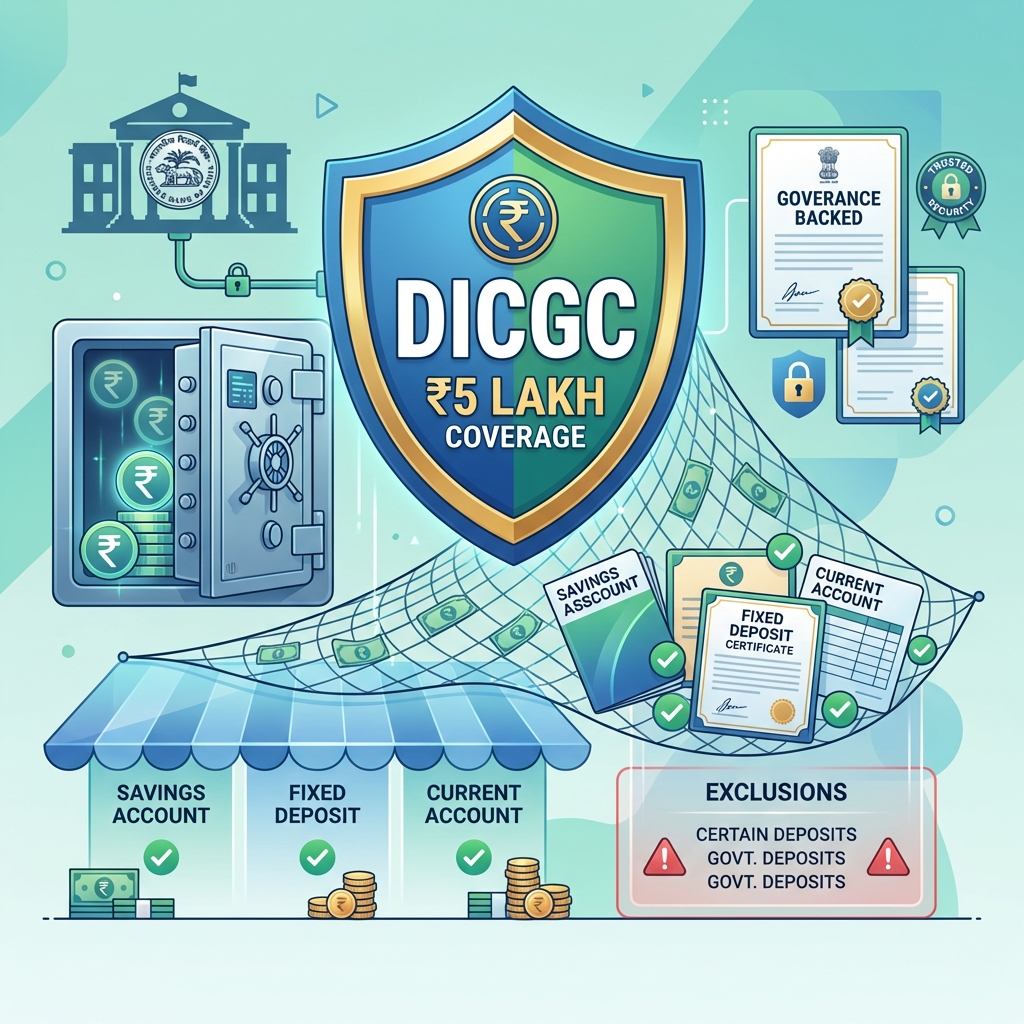
- DICGC insurance protects up to ₹5 lakh per depositor per bank.
- Coverage includes savings accounts, FDs, RDs, and current accounts.
- RBI acts as guardian with regular inspections and capital requirements.
- Smart strategy: Spread deposits across multiple banks to maximize protection.
- Not all institutions are covered—verify RBI registration before depositing.
You walk into a bank, deposit your hard-earned money, and trust that it will be there whenever you need it. But what if the bank itself fails? What happens to your savings, your fixed deposits, and your financial security?
This isn't a hypothetical question. In India's banking history, we've seen banks face crises—from Yes Bank's moratorium in 2020 to Punjab & Maharashtra Cooperative Bank's restrictions. Understanding bank safety mechanisms is a crucial part of personal finance literacy in India.
The Safety Net: DICGC Deposit Insurance
The Deposit Insurance and Credit Guarantee Corporation (DICGC) is a subsidiary of the Reserve Bank of India (RBI) that provides insurance coverage to bank depositors. Think of it as a financial safety net that catches you if your bank falls.
₹5 Lakh Coverage Per Bank, Per Depositor
DICGC insures each depositor up to a maximum of ₹5 lakh (both principal and interest) across all their accounts in one bank. This means your savings account, FD, and recurring deposit are protected up to this combined limit.
How the ₹5 Lakh Limit Works
The coverage is per depositor per bank, not per account. Let's say you have:
- ₹2 lakh in a savings account
- ₹3 lakh in a fixed deposit
- ₹1 lakh in a recurring deposit
Total = ₹6 lakh. In case of bank failure, you would receive only ₹5 lakh from DICGC. The remaining ₹1 lakh would be part of the bank's liquidation process, which could take years.
What Deposits Are Covered?
DICGC covers most common deposit types in scheduled commercial banks, small finance banks, payment banks, and cooperative banks registered with RBI:
✅ Covered Deposits:
- Savings Accounts: Your everyday banking deposits
- Fixed Deposits (FDs): Term deposits with fixed interest rates
- Recurring Deposits (RDs): Monthly installment-based deposits
- Current Accounts: Business and operational accounts
- NRE/NRO Accounts: Non-resident Indian deposits (with conditions)
❌ NOT Covered:
- Deposits in foreign bank branches (outside India)
- Government deposits
- Inter-bank deposits
- Deposits with state, central, or local governments
- Amounts under litigation or seized by court orders
What Happens If a Bank Fails?
When a bank faces severe financial distress, the RBI can impose a "moratorium" (temporary restriction on withdrawals) or cancel the bank's license entirely. Here's the typical timeline:
- RBI Intervention (Day 0): RBI places the bank under moratorium or cancels its license
- DICGC Activation (Within 45-60 days): DICGC starts processing claims up to ₹5 lakh per depositor
- Payment to Depositors (Within 90 days): Insured amount is transferred directly to depositors' accounts
- Liquidation Process (Months/Years): For amounts above ₹5 lakh, depositors become creditors in the liquidation process
Real Example: When Punjab & Maharashtra Cooperative Bank faced restrictions in 2019, depositors with balances under ₹5 lakh received full protection, while those with larger deposits faced years of uncertainty. Understanding liquidity becomes crucial in such situations.
RBI's Role in Bank Safety
The Reserve Bank of India acts as the guardian of India's banking system through multiple mechanisms:
1. Regular Inspections
RBI conducts annual inspections of all banks to check their financial health, capital adequacy, and risk management practices.
2. Capital Requirements
Banks must maintain a minimum Capital Adequacy Ratio (CAR) of 9% for scheduled commercial banks (higher than the global Basel III requirement of 8%). This ensures banks have enough capital to absorb losses.
3. Early Warning System
RBI uses a "Prompt Corrective Action" (PCA) framework to identify weak banks early and take preventive measures before they fail.
4. Deposit Insurance Fund
All commercial banks contribute to the DICGC fund regularly, which currently holds over ₹1.5 lakh crore to protect depositors.
How to Maximize Your Protection
Smart depositors use these strategies to ensure their money stays safe:
1. Spread Across Multiple Banks
Since insurance is ₹5 lakh per bank, diversify your deposits across 2-3 reputable banks. If you have ₹15 lakh to deposit:
- ₹5 lakh in Bank A (Fully insured)
- ₹5 lakh in Bank B (Fully insured)
- ₹5 lakh in Bank C (Fully insured)
This strategy aligns with the principle of diversification—never put all your eggs in one basket.
2. Choose Systemically Important Banks
RBI designates certain large banks as "Domestic Systemically Important Banks" (D-SIBs) like SBI, ICICI, and HDFC Bank. These banks have extra regulatory oversight and are considered "too big to fail."
3. Keep an Emergency Fund Liquid
Maintain your emergency fund (3-6 months of expenses) in a highly liquid form, not just FDs. Use a combination of:
- Savings account (instant access)
- Liquid mutual funds (1-2 day redemption)
- Short-term FDs (with premature withdrawal option)
4. Monitor Bank Health
Stay informed about your bank's financial health:
- Check annual reports for NPA (Non-Performing Assets) ratios
- Look for RBI warnings or PCA framework placements
- Monitor credit ratings from agencies like CRISIL or CARE
- Track where your money is parked using budgeting tools
5. Avoid Unregistered Schemes
Many cooperative societies and chit funds claim to offer "bank-like" safety but aren't covered by DICGC. Always verify if your institution is:
- Registered with RBI
- Listed on DICGC's official website
- Operating under proper banking regulations
Falling for unregistered schemes can lead to permanent loss of savings or a debt trap.
Beyond DICGC: Other Safety Measures
Know Your Customer (KYC)
Proper KYC verification protects both you and the bank from fraud. Always complete your KYC to ensure smooth claim processing if something goes wrong.
Digital Payment Safety
In the age of UPI and digital banking, protect your accounts from cyber fraud:
- Never share your OTP, PIN, or CVV
- Enable two-factor authentication
- Regularly monitor your bank statements
- Use secure networks for online transfers
Your Money's Guardian Angels
Indian bank deposits are among the safest in the world, thanks to a robust three-layer protection system:
- RBI Regulations: Preventive supervision and capital requirements
- DICGC Insurance: ₹5 lakh guarantee per bank per depositor
- Government Backing: Implicit guarantee for public sector banks
However, safety doesn't mean complacency. Smart savers:
- Diversify across multiple banks
- Never exceed ₹5 lakh in a single bank (unless necessary)
- Keep emergency funds liquid and accessible
- Stay informed about their bank's health
Remember: Your bank deposits are just one part of your overall net worth. For long-term wealth building that beats inflation, consider moving beyond deposits into mutual funds, index funds, and other growth assets through systematic SIP investments.
Your journey to financial independence requires both safety and growth. DICGC ensures the safety part—now it's up to you to build the growth part wisely.
What next?
→ Calculate your net worth to see your complete
financial picture
→ Understand assets vs liabilities to build true
wealth
→ Build your emergency fund for financial
security