Key Takeaways
- Debit cards use your own money from your savings account—no debt, no credit score impact.
- Credit cards are loans you must repay—builds CIBIL score if used responsibly, destroys it if misused.
- Credit cards offer better fraud protection—you dispute the bank's money, not your own.
- 45-50 day interest-free period on credit cards can be powerful if you pay in full every month.
- Misusing credit cards = 36-42% interest—one of the fastest ways to fall into a debt trap.
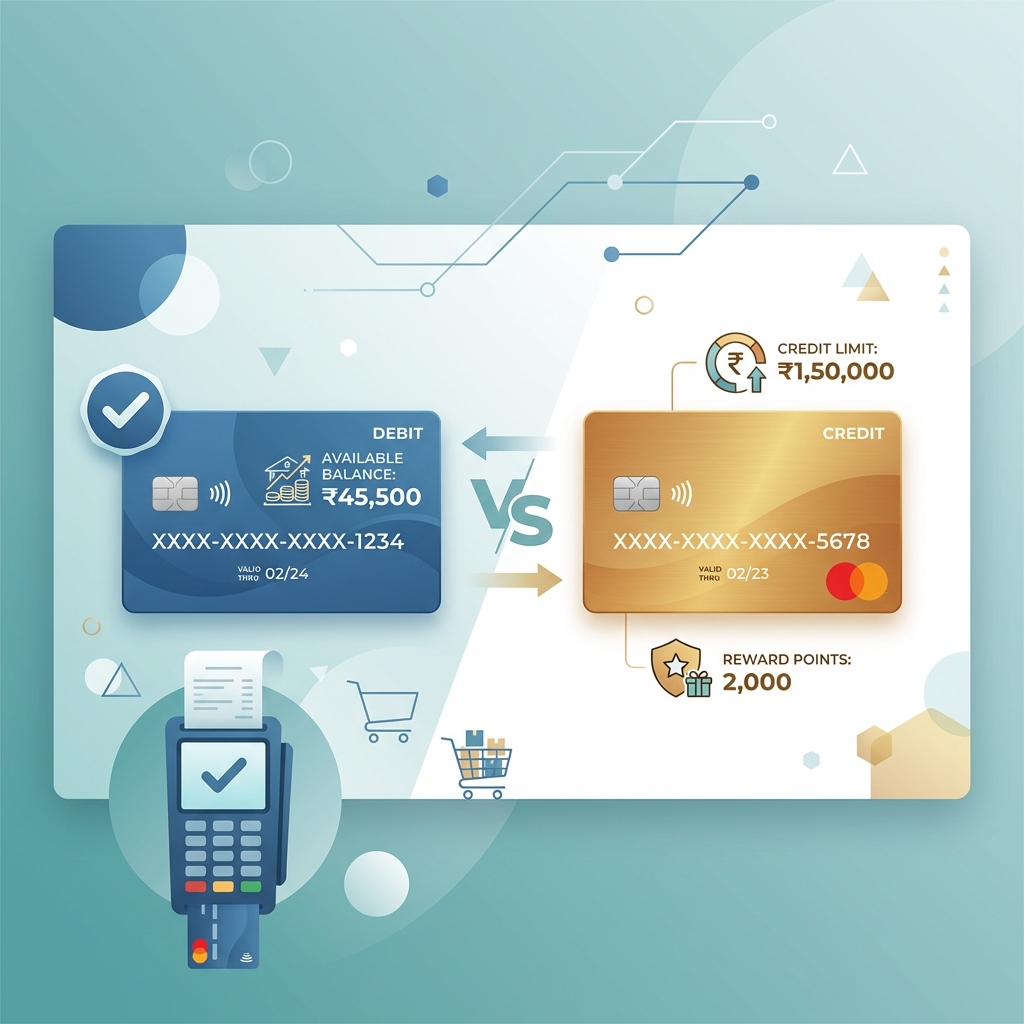
They look nearly identical—the same rectangular shape, a shiny microchip, and a magnetic strip on the back. Both fit perfectly into your wallet and can buy you the same cup of coffee or the same pair of shoes. But under the surface, Debit vs Credit card is a battle between two completely different financial philosophies.
One represents what you own, while the other represents what you owe. Understanding the difference is not just about banking terminology; it's about mastering the psychology of spending and leverage—a key concept in personal finance management.
The Debit Card: Your Real-World Wallet
A debit card is directly linked to your savings account. When you swipe a debit card, the bank checks if you have enough balance, and the money is instantly deducted from your account.
How It Works:
- You swipe/tap at a store or ATM
- Bank checks balance in your savings account
- If sufficient → Transaction approved, money deducted instantly
- If insufficient → Transaction declined (no debt created)
The Discipline Factor
The greatest advantage of a debit card is realism. You cannot spend ₹10,000 if you only have ₹8,000 in your account. It prevents you from falling into debt traps because it forces you to face the reality of your current balance with every transaction.
For many young Indians starting their financial journey, the debit card is the safest way to build a relationship with money. Use it alongside the 50/30/20 rule to stay within your budget.
Pros of Debit Cards:
- ✅ No debt risk — Can only spend what you have
- ✅ No interest charges — Ever
- ✅ Simple to use — Just like cash, but digital
- ✅ No credit score impact — Can't hurt your CIBIL
- ✅ No annual fees — Most banks offer free debit cards
Cons of Debit Cards:
- ❌ No credit history — Doesn't build CIBIL score
- ❌ Weaker fraud protection — Your actual money is at risk during disputes
- ❌ Limited rewards — Minimal cashback or points compared to credit cards
- ❌ No emergency buffer — If account balance is ₹0, you can't transact
The Credit Card: Spending the Bank's Money
A credit card is a "loan in your pocket." When you swipe it, the money doesn't come from your bank account. Instead, the credit card company pays the merchant on your behalf. You are essentially borrowing that money for a short period—usually up to 45-50 days interest-free.
How It Works:
- You swipe/tap the credit card
- Bank pays the merchant immediately
- You owe the bank that amount (added to your monthly bill)
- Billing cycle ends (usually monthly) and you receive a statement
- You have 15-20 days to pay the bill (grace period)
-
Two outcomes:
- ✅ Pay full amount → No interest charged
- ❌ Pay partial/late → 36-42% annual interest applied
The Leverage Game
The "credit" in the name refers to the credit limit the bank has given you based on your income and credit history. You spend today and pay the bill next month. If you pay the full amount on time, it's essentially free money for 45-50 days. If you miss the payment, you're hit with some of the highest interest rates in India—often 36% to 42% annually.
Example: The Cost of Paying Only the Minimum
You have a ₹50,000 credit card bill. The minimum payment is ₹1,000 (2%).
If you pay only ₹1,000:
- Remaining balance: ₹49,000
- Interest charged (3% monthly): ₹1,470
- New balance: ₹50,470
After 1 year of minimum payments, you'll have paid ₹18,000+ in interest and still owe ₹45,000+. This is how credit card debt becomes a trap.
Pros of Credit Cards:
- ✅ Builds credit score — Essential for future loans (home, car)
- ✅ 45-50 day interest-free period — Free short-term loan if paid in full
- ✅ Better fraud protection — Bank's money is at risk, not yours
- ✅ Rewards & cashback — Points, airline miles, shopping discounts
- ✅ Emergency buffer — Access to funds when bank account is low
- ✅ Purchase protection — Insurance on high-value purchases
Cons of Credit Cards:
- ❌ High interest rates — 36-42% annually if not paid in full
- ❌ Easy to overspend — "Free money" illusion leads to debt
- ❌ Annual fees — ₹500-₹5,000+ per year (waived if you spend enough)
- ❌ Late payment penalties — ₹500-₹1,500 per missed payment
- ❌ Destroys CIBIL if misused — Missed payments stay on record for 7 years
Debit vs Credit Card: Side-by-Side Comparison
| Feature | Debit Card | Credit Card |
|---|---|---|
| Source of Funds | Your savings account | Bank's money (loan) |
| Debt Risk | Zero—can't spend what you don't have | High—easy to overspend |
| Interest Charges | None | 36-42% if not paid in full |
| CIBIL Score Impact | No impact (not reported) | Major impact (builds or destroys) |
| Fraud Protection | Weak—your money is at risk | Strong—bank's money is at risk |
| Rewards/Cashback | Minimal (0.25-0.5%) | High (1-5% + bonus points) |
| Annual Fees | Usually free | ₹500-₹5,000+ (often waivable) |
| Best For | Daily expenses, budgeting | Big purchases, credit building |
The Wealth-Building Secret: Credit Score
This is where the credit card wins in the long run. To get a home loan or car loan at a lower interest rate in the future, you need a high CIBIL score (750+).
Since a debit card transaction is just you spending your own money, banks don't report it to credit bureaus. Your CIBIL score remains unaffected—neither improving nor worsening.
However, every time you use a credit card and pay it back diligently, you're telling the financial system: "I am a trustworthy borrower." This "proof of trust" can save you lakhs of rupees in interest over your lifetime.
Example: CIBIL Score Impact on Home Loan
Loan amount: ₹50 lakh for 20 years
- CIBIL 800+: Interest rate 8.5% → Total interest paid = ₹53 lakh
- CIBIL 650: Interest rate 10.5% → Total interest paid = ₹67 lakh
Difference: ₹14 lakh saved just because you used a credit card responsibly for 5 years!
When to Use Which Card: The Pro Strategy
Use Debit Card For:
- ✅ Daily essentials (groceries, fuel, small bills)
- ✅ ATM withdrawals (free withdrawals on most debit cards)
- ✅ Budgeting practice (forces you to stay within limits)
- ✅ When you're still learning financial discipline
Use Credit Card For:
- ✅ High-value purchases (₹10,000+) — Better protection and rewards
- ✅ Online shopping — Fraud protection is critical
- ✅ Travel bookings — Flight/hotel insurance, no forex markup on international cards
- ✅ Building credit score — Pay in full every month
- ✅ Emergency expenses — Only if you have a repayment plan
The Golden Rule of Credit Cards
Never buy anything on a credit card that you can't afford to pay for in cash today.
If you don't have ₹50,000 in your bank account, don't spend ₹50,000 on your credit card. The interest-free period is a tool for cash flow management, not a license to overspend.
5 Common Credit Card Mistakes to Avoid
1. Paying Only the Minimum Due
The minimum payment (usually 2-5% of total) keeps your account active, but 36-42% interest is charged on the remaining balance. Pay the total amount due, not the minimum.
2. Treating Credit Limit as Income
Just because you have a ₹2 lakh credit limit doesn't mean you should spend ₹2 lakh. Treat it as an emergency buffer, not bonus money.
3. Missing Payment Deadlines
Set up auto-pay or calendar reminders. A single missed payment can drop your CIBIL score by 50-100 points and stay on your record for 7 years.
4. Withdrawing Cash from Credit Card
Cash withdrawals on credit cards have no interest-free period. Interest starts immediately at 2.5-3.5% per month + ₹300-₹500 withdrawal fee. Avoid at all costs.
5. Ignoring the Statement
Review your monthly statement for:
- Fraudulent transactions
- Incorrect charges
- Spending patterns (are you overspending?)
Which Card Should You Start With?
Start with a Debit Card if:
- You're new to managing money (age 18-22)
- You struggle with impulse spending
- You don't have a steady income yet
- You haven't built financial discipline (tracking expenses, budgeting)
Graduate to a Credit Card when:
- You have 6+ months of expense tracking
- You have a steady income (job/business)
- You've built an emergency fund (3-6 months expenses)
- You can commit to paying the full bill every month
The Ideal Strategy:
Use both together:
- Debit card for daily expenses and ATM withdrawals
- Credit card for large purchases, online shopping, and building credit score
- Auto-pay credit card bill in full from your salary account
The Bottom Line: It's About Discipline, Not Cards
The final verdict on the Debit vs Credit card debate isn't about the cards themselves—it's about you. A credit card is a powerful magnifying glass. If you're disciplined, it magnifies your wealth through rewards and credit scores. If you're impulsive, it magnifies your debt through interest and late fees.
Action Steps:
- ✅ Start with a debit card to build spending discipline
- ✅ Track every expense for 3 months using a budget app
- ✅ Build a 3-month emergency fund before getting a credit card
- ✅ When ready, apply for a basic credit card (not premium)
- ✅ Set auto-pay for full bill payment (never miss a due date)
- ✅ Use credit card for rewards, but spend as if using debit
- ✅ Check CIBIL score every 6 months to track progress
Master the debit card first. Once you have a consistent habit of tracking your spending, only then step into the world of credit.
What to read next:
→ CIBIL Score Guide — How to build and maintain
750+ score
→ Clear Credit Card Debt — 7-step recovery
strategy
→ Good vs Bad Debt — Understanding leverage