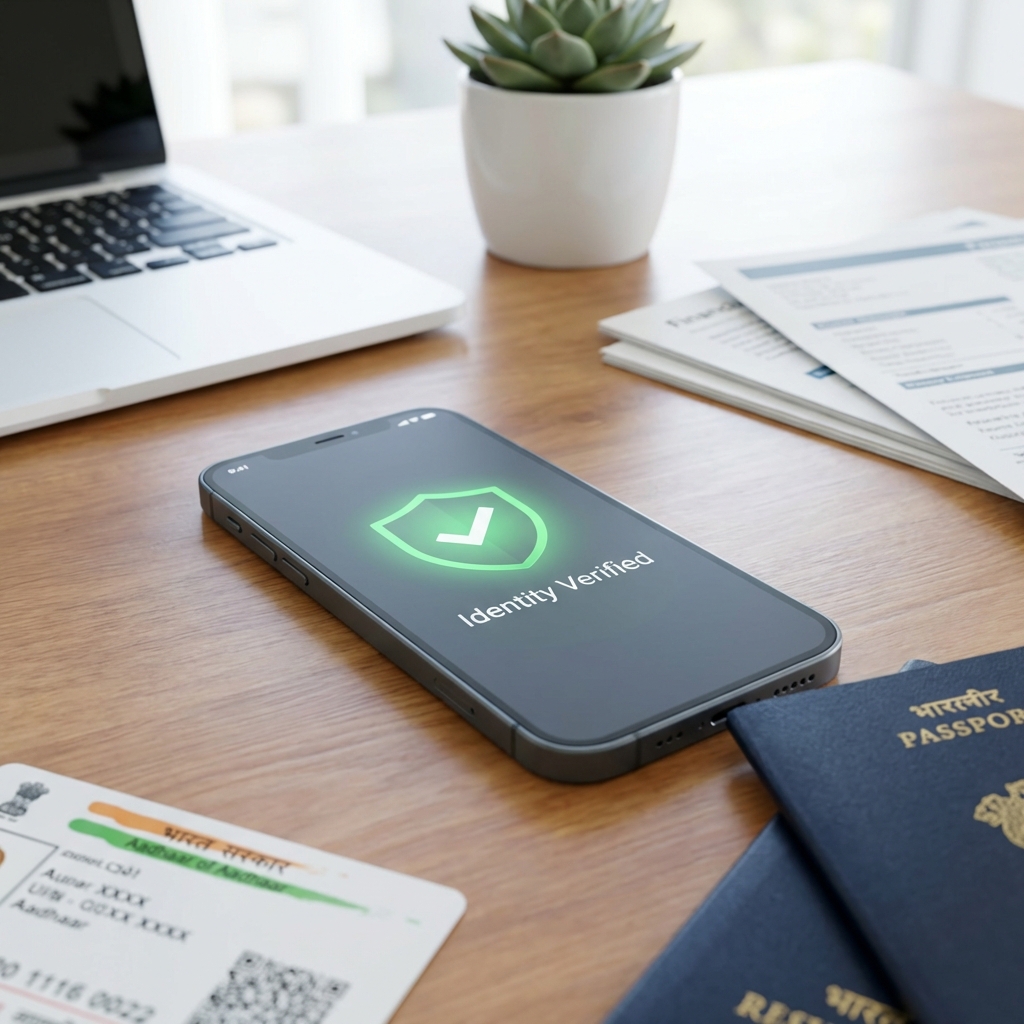
Imagine walking into a bank for the first time. You want to open a savings account to start your financial journey. Before the bank takes your money, they ask for a series of documents: your Aadhaar card, your PAN card, and perhaps a photo. This process can sometimes feel like a bureaucratic hurdle, but it is actually one of the most important layers of protection in modern finance.
This process is called KYC (Know Your Customer). It is not just a bank's internal policy; it is a global standard and a mandatory legal requirement in India. But what exactly is the KYC meaning, and why does it matter so much to you as a consumer?
The Core Definition: What Is KYC?
KYC is the process of a business verifying the identity of its clients and assessing potential risks of illegal intentions for the business relationship. In the context of banking, it ensures that financial institutions are not being used, intentionally or unintentionally, by criminal elements for money laundering or fraud.
For you, the customer, KYC is proof that the bank knows exactly who is accessing the account, making it much harder for someone to steal your identity or open accounts in your name without your knowledge.
Why Do Banks Need It?
The primary reason is security. By identifying every customer, the RBI (Reserve Bank of India) can ensure that the money flowing through the system is legitimate. KYC helps in:
- Preventing Money Laundering: Ensuring 'dirty' money isn't introduced into the clean financial system.
- Stopping Identity Theft: Verifying that 'You' are actually 'You' before any high-value transactions or account changes.
- Curbing Terrorism Financing: Tracking funds to ensure they aren't reaching illegal organizations.
By understanding how KYC meaning impacts your access to financial tools, you are taking the first step into the world of regulated Banking. It is not just about a document; it is about your identity in a global economy.
Documents Required for KYC in India
The documents required are generally divided into two categories:
- Proof of Identity (PoI): Aadhaar, Passport, Voter ID, PAN Card, or Driving License.
- Proof of Address (PoA): Utility bills (electricity/phone), Bank statement, or Rent agreement (along with one of the PoI documents mentioning the address).
The Digital Shift: e-KYC and Video KYC
Gone are the days when you had to take physical photocopies of all your documents to a bank branch. India’s digital infrastructure has made the process incredibly seamless:
- e-KYC: This uses your Aadhaar number and a one-time password (OTP) sent to your registered mobile number to instantly verify your details.
- Video KYC: Many banks now allow you to complete the entire process through a recorded video call with a bank official, where you show your original PAN card and sign a piece of paper on camera. It’s convenient, safe, and can be done from your living room.
The Concept of Re-KYC
KYC is not a "one-and-done" process. Banks are required to update their records periodically. This is called Re-KYC. High-risk accounts may need verification every 2 years, while low-risk accounts might only need it once in 10 years. If your bank asks for an update, don't ignore it; failing to complete Re-KYC can lead to your account being temporarily frozen.
Protecting Your KYC Data
While KYC is for your security, your KYC documents are highly sensitive. Scammers often use "fake KYC updates" as a way to steal your information.
- Never share OTPs with over-the-phone "agents" claiming to update your KYC.
- Don't click random links in SMS messages that say "Your KYC is expiring, click here to update."
- Always use the official bank mobile app or visit the branch for verification.
The Gateway to Financial Inclusion
KYC might feel like paperwork, but it is actually the gateway to the modern financial world. Without it, the trust that allows us to send money via UPI or transfer lakhs via RTGS wouldn't exist. It is the silent protector of your financial identity, ensuring that the Indian banking system remains world-class, transparent, and safe for everyone.