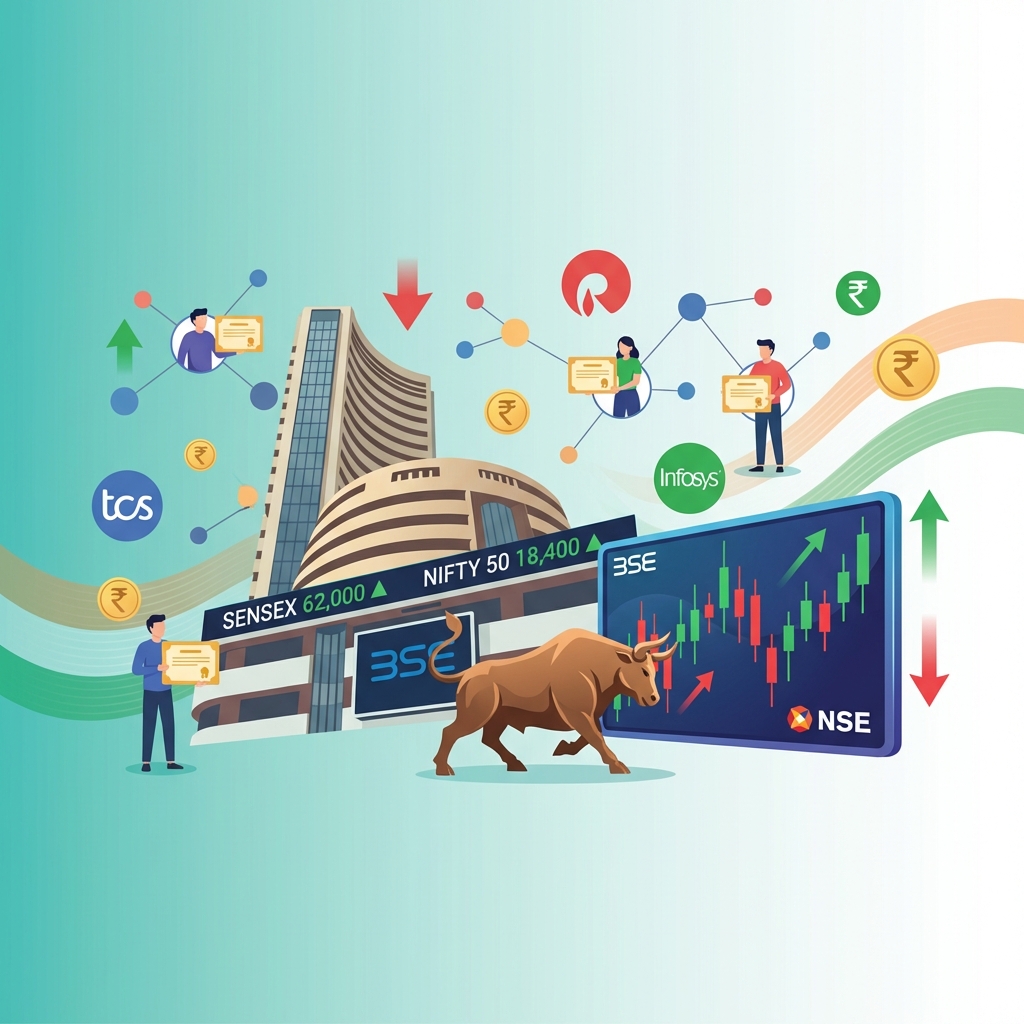
If you've ever wondered where the news gets those dramatic headlines—"Sensex crashes 500 points!" or "Nifty hits all-time high!"—you're about to find out. And it's a lot less mysterious than it sounds.
In India, we have a complicated relationship with the stock market. Some people treat it like a casino—quick bets, quick wins (or losses). Others treat it like black magic, something only "experts" can understand. Your relatives probably have horror stories about the 1992 Harshad Mehta scam or the 2008 crash.
But here's the thing: the stock market is neither gambling nor black magic. It's simply a marketplace. And understanding how it works is essential if you want to build long-term wealth in India.
What Exactly Is a "Share" or "Stock"?
Let's start with a simple example. Imagine you open a chai stall with your friend. The startup cost is ₹1 lakh. You put in ₹50,000, your friend puts in ₹50,000. You both now own 50% of the business.
That 50% ownership stake? That's your "share" of the company.
Now scale this up. When massive companies like Reliance or Tata need to raise money—maybe to build a new factory, expand operations, or fund research—they can't just ask friends and family. The amounts are too large.
So they divide their company into millions (or billions) of tiny ownership pieces called "shares" or "stocks," and offer them to the public. When you buy one share of Infosys, you're not buying a piece of paper or a number on a screen. You're buying a tiny slice of actual ownership in that company.
If the company grows and becomes more valuable, your slice becomes more valuable. If it does well and makes profits, you may receive a portion of those profits as dividends. That's the core of equity investing.
Where Do You Buy Shares? Meet BSE and NSE
You can't walk into a shop and buy shares like you'd buy groceries. Shares are bought and sold on "Stock Exchanges"—regulated marketplaces where buyers and sellers meet (electronically these days).
India has two major stock exchanges:
1. BSE (Bombay Stock Exchange)
Founded in 1875, BSE is Asia's oldest stock exchange and an iconic part of Mumbai's financial history. It's located on Dalal Street, which has become synonymous with Indian finance. Over 5,000 companies are listed on BSE, though not all actively trade. The exchange's benchmark index is the Sensex, which tracks 30 of the largest companies.
2. NSE (National Stock Exchange)
Founded in 1992, NSE is newer but now handles higher trading volumes than BSE. It was India's first fully electronic exchange —no physical trading floor, everything digital. Most retail investors today trade primarily on NSE. Its benchmark index is the Nifty 50, tracking the top 50 companies.
Think of BSE and NSE like Swiggy and Zomato. Both let you order food (or in this case, buy shares). The restaurants (companies) are often listed on both platforms. The core product is the same; the marketplace is just different.
Many Indian companies are "dual-listed"—meaning you can buy their shares on both BSE and NSE. The price is usually nearly identical due to market forces (a concept called arbitrage).
Sensex and Nifty: Understanding Market Indices
You've definitely heard news anchors say things like: "Sensex crashed 800 points today!" "Nifty closed at an all-time high!"
But what do these numbers actually mean?
There are thousands of companies listed on Indian stock exchanges. You can't possibly track every single one to understand whether the overall market is doing well or poorly. That's where indices (or indexes) come in.
An index is like a representative sample—a snapshot of overall market health.
- Sensex (Sensitivity Index): Tracks 30 of the largest and most actively traded companies on BSE. These include giants like Reliance, TCS, Infosys, HDFC Bank, etc. When people say "the Sensex," they're referring to the combined performance of these 30 companies.
- Nifty 50: Tracks the top 50 companies listed on NSE, spanning various sectors (IT, banking, pharma, automobiles, etc.). This is the most widely followed benchmark for the Indian stock market.
If most of these companies' stock prices go up, the index goes up. If they fall, the index falls. Think of it as an average temperature reading for the entire market.
Why Do Indices Go Up and Down?
Stock prices are driven by supply and demand. If more people want to buy a stock than sell it (maybe the company announced strong quarterly profits), the price rises. If there's panic—say, due to global uncertainty or bad economic news—and more people want to sell, prices drop. Indices reflect these collective movements across top companies. Learn more about what drives stock prices.
How Do You Actually Buy Shares?
Gone are the days when you had to physically visit a stock exchange or call a broker on a landline. Today, buying shares is as simple as ordering food online.
But you still need an intermediary—called a broker—to facilitate your trades. In the digital age, brokers are apps on your phone (Zerodha, Groww, Upstox, etc.).
Here's the general process:
- Open a Demat Account: Short for "Dematerialized Account," this is where your shares are stored digitally (like a bank account, but for stocks). You'll also get a linked trading account for buying/selling.
- Complete KYC: You'll need PAN card, Aadhaar, bank details, and proof of address for KYC verification.
- Add Funds: Transfer money from your bank account to your trading account.
- Search and Buy: Search for the company (e.g., "TCS" or "Infosys"), enter the quantity, and place a buy order.
- Settlement: Within 1-2 business days (called T+1 settlement), the shares are credited to your Demat account and money is debited.
Most platforms charge a small brokerage fee or transaction charge. Some platforms like Zerodha offer zero brokerage on delivery trades.
Investing vs. Trading: Know the Difference
This is one of the most important distinctions in the stock market—and one that often gets blurred.
- Trading: Buying and selling stocks frequently—sometimes within the same day (intraday trading) or over short periods (days, weeks). The goal is to profit from short-term price movements. This requires constant monitoring, technical analysis skills, and carries high risk. It's essentially a full-time job.
- Investing: Buying shares of fundamentally strong companies (or mutual funds / index funds) and holding them for years or even decades. The goal is wealth creation through business growth and compounding. This is passive and historically more reliable for most people.
At MoneyExplain, our content focuses on long-term investing principles, not short-term speculation. We believe in building wealth systematically, not chasing quick gains.
Don't Be Scared of Volatility
The market is like a heart monitor; it goes up and down. That means it’s alive. A flat line means death. If you stay invested in good companies (or Mutual Funds) for 5-10 years, history shows that the Indian stock market has beaten every other asset class like Gold or FDs.